Chiminea vs Outdoor Fireplace: Which One Fits Your Backyard?
A built outdoor fireplace is a permanent structure: a large firebox, a tall chimney, a foundation under it and, usually, a contractor to build it. A chiminea is a freestanding clay or metal fireplace you set on pavers and can move when it’s cold. One is a backyard project, the other is an object. Choose by the space you have, what you want to spend and how permanent you want the fire to be.
We make clay chimineas, so we have a side. We’ll still be fair about where a built fireplace wins, because for some backyards it’s the right answer.
What counts as an outdoor fireplace?
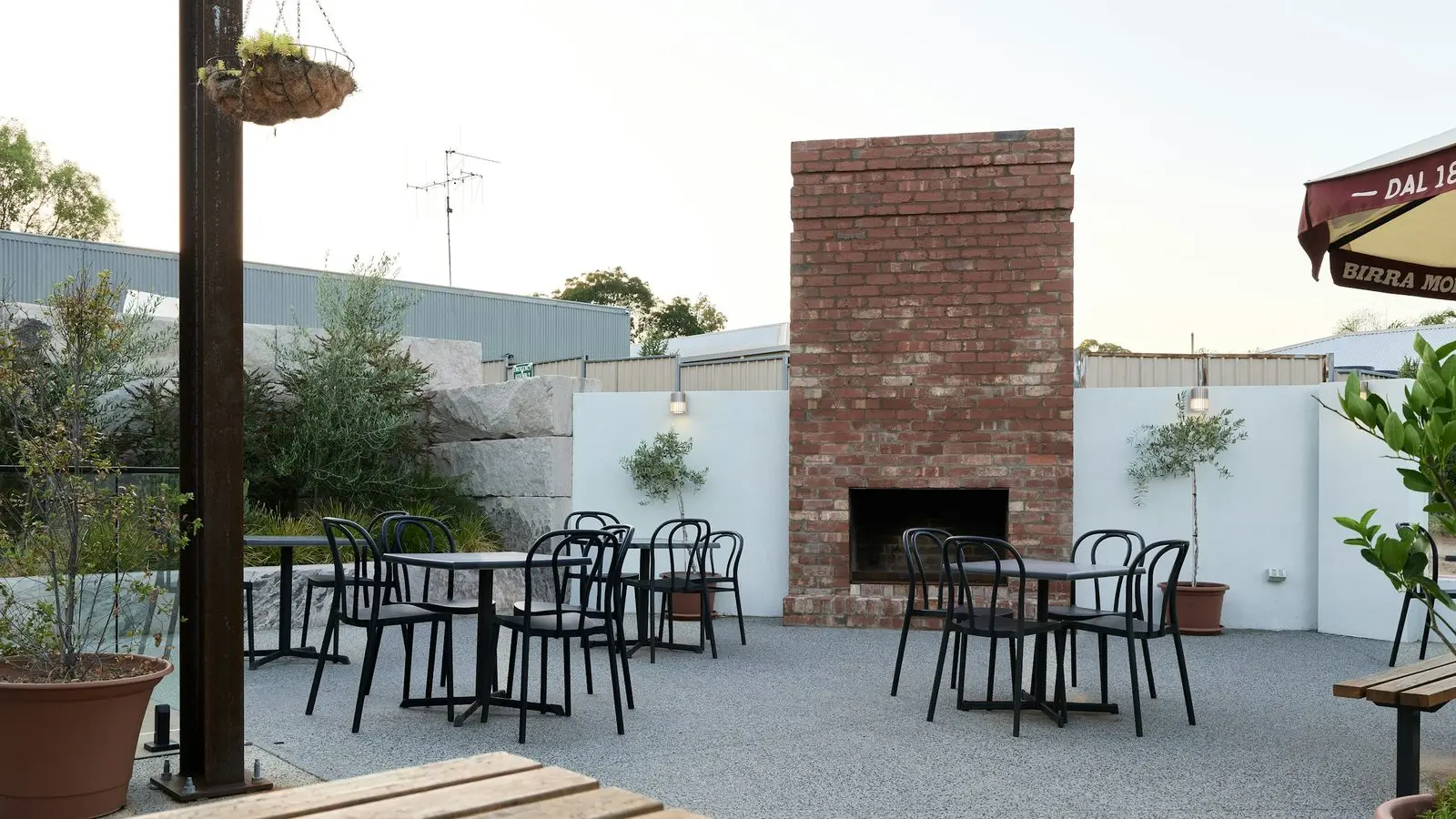
Here, an outdoor fireplace means a fireplace built in place, of brick, stone or block, or assembled from a heavy masonry kit: a firebox with an opening on one side and a chimney that rises well above head height. It’s designed as the focal point of a patio or outdoor room and it stays where it’s built. A chiminea is a smaller, freestanding fireplace with its own short chimney, made of fired clay or cast metal. For the basics of how it works, see what is a chiminea.
Space and permanence
An outdoor fireplace takes over a part of the yard for good. It needs room for the structure itself, a solid foundation and a seating area in front. It’s a design decision as much as a fire. A chiminea needs a non-combustible base, open sky above it and 6-10 ft (2-3 m) from walls, fences and fabric furniture. You can try it in one corner this summer and another next year. Ours stands 34 in (87 cm) tall on its tripod stand and weighs 38-44 lbs, so one person can move it when it’s completely cold.
Installation
- Outdoor fireplace: a construction project. Foundation, masonry, chimney, and often a professional. Many places have rules for permanent structures and their distance from the house and property lines, so check with your local building department before you plan one.
- Chiminea: set the stand on pavers, place the body on top, cure it with a few small fires, and it’s ready. No foundation, no tools.
Heat
A big masonry firebox holds a big fire and a lot of mass, so it can throw heat across a seating area once it’s going, and the stone stays warm for a long time. A chiminea warms the people sitting in front of it: heat comes out of the front opening, and the clay walls take in heat and give it back gradually. Neither heats an entire open yard. If you picture a large group in a wide circle on cold nights, the fireplace has the edge; for a few chairs in a half circle, a chiminea is plenty.
Smoke
Both lift smoke with a chimney, which already beats an open fire pit. A tall built chimney carries smoke higher than a chiminea’s short one. With either, the smoke you get depends mostly on the wood: seasoned hardwood and a moderate fire make far less than wet wood or a fire left to smolder.
Cooking
A built fireplace can be designed around cooking, with a grill grate, a hearth for a Dutch oven or even a pizza oven next to it. A clay chiminea is a fireplace first: you can cook simple things over the embers, on skewers or in foil, but a heavy grate on the opening overstresses the clay. If cooking is the main reason, the built option, or a cast iron chiminea, fits better. Our chiminea vs fire pit comparison covers the open-fire alternative too.
Cost
We won’t put numbers on someone else’s construction job; they vary enormously with materials, size and labor. The difference in kind is clear, though: an outdoor fireplace is a building project with materials and labor, while a chiminea is a single product. Our own clay chimineas are currently sold out in the US, so the product pages are there for specs and reference prices.
Upkeep
A masonry fireplace lives outside year-round; it needs the chimney and joints checked now and then. A clay chiminea needs three habits: curing at the start, no water on hot clay, and a dry place in winter, because water that freezes inside the clay can crack it. Cast iron chimineas can stay out, but they rust and need high-heat paint.
Which one fits your backyard?
- You own the house, have room for a permanent feature and want a large group around the fire: an outdoor fireplace.
- You rent, have a smaller patio, want to try the fire before committing, or like moving things around: a chiminea.
- You want something that looks good unlit, as a handmade piece: a clay chiminea.
Our chiminea, in short
Sparkle Stone chimineas are handmade from 100% natural, kiln-fired clay rated for 500-600°C (932-1112°F). They stand 34 in (87 cm) tall on the included tripod stand and come with a protective lid. See our clay chimineas or the red ornamented version.
Is a chiminea cheaper than an outdoor fireplace?
In kind, yes: a chiminea is a single product, while an outdoor fireplace is a construction project with materials and labor. Exact costs for a built fireplace depend on the design and the builder.
Does an outdoor fireplace give more heat than a chiminea?
A large masonry fireplace can hold a bigger fire and warm a wider seating area. A chiminea warms the people sitting in front of its opening.
Can you move a chiminea once it’s set up?
Yes. A chiminea moves when it’s completely cold, lifted by the body, not the chimney. A built outdoor fireplace stays where it was built.
Do you need a permit for an outdoor fireplace?
It depends on where you live. Permanent structures often have local rules, so check with your building department before you plan one.