
How to Choose a Chiminea: 9 Things to Check Before You Buy
The best chiminea is the one that fits the spot you actually have and the care you’re willing to give it. Before you buy, check nine things: the material, the space it needs, size and weight, the opening and bowl, whether a stand and lid are included, how it’s made, the upkeep, what happens if it arrives damaged, and what the price really covers.
“Best chiminea” lists rank products. This is the checklist we’d want anyone to use before buying one, from us or anywhere else. We make one model in two colors, so we’re not going to pretend there’s a ranking here.
1. Clay or cast iron?
Decide this first, because it changes everything else. Fired clay gives gentler, more even warmth, never rusts and looks good unlit, as a piece of ceramic. It does need protecting from sudden changes: no water on hot clay, and no frost while the clay is damp. Cast iron and steel shrug off knocks, cold and big fires, but they rust and need high-heat paint now and then. The full comparison is in clay vs cast iron chiminea.
2. Do you have the right spot?
Start with the place, not the product photo. Any wood-burning chiminea needs:
- a non-combustible base: concrete pavers, stone or brick, or a protected zone of about 1 x 1.2 m (roughly 3 x 4 ft) on a deck;
- 6-10 ft (2-3 m) from walls, wooden fences and fabric furniture;
- open sky above the chimney: no roof, eaves, pergola or branches.
If the only spot you have is a covered porch or under a pergola, hold off. No wood-burning chiminea belongs there. Surfaces, including gravel, grass and decks, are covered in what to put under a chiminea.
3. Size and weight
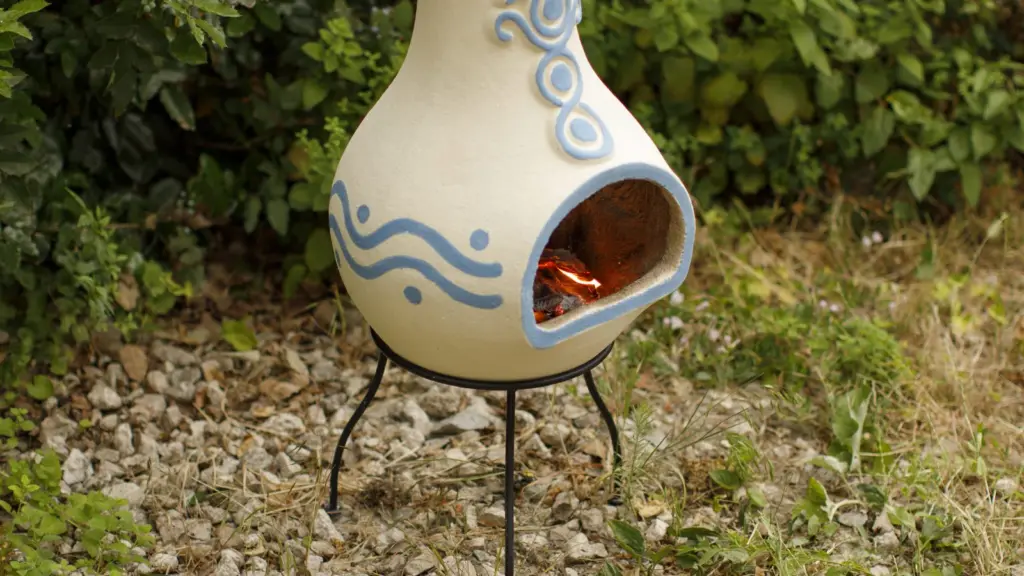
Height affects the draft and how comfortably you can feed the fire. Weight affects moving it: a clay chiminea only moves when it’s completely cold, lifted by the body, never by the chimney. For reference, ours stands 34 in (87 cm) tall on its tripod stand and weighs 38-44 lbs (17.2-19.9 kg). The range is there because each one is handmade. One person can carry it, carefully, from the patio to the garage and back.
4. The opening and the bowl
Look at the front opening. It should be wide enough to take ordinary split logs without forcing them, but not so wide that the fire spills out. The bowl underneath should be deep and wide, so embers and sparks stay inside. In ours, the fire sits on a layer of sand about 4 in (10 cm) deep, which protects the bottom of the bowl.
5. Stand and lid
Check whether the stand is included or sold separately, and whether it sits level with no wobble. A chiminea that leans draws poorly and leaves soot on the outside. A lid keeps rain out of the chimney between uses; without one, the sand and base get soaked, and damp clay should never be heated quickly. Ours comes with both, a protective lid and a tripod stand, so there’s nothing else to buy before the first fire.
6. Handmade or molded?
A handmade chiminea varies slightly in shape and color from one piece to the next. That’s the maker’s hand, not a flaw. The relief ornaments on ours, light red or light blue on a cream body, fall a little differently on every piece, and the color intensity can vary. If you want identical, catalog-perfect pieces, look for a molded product. If you want an object with character, ask who makes it and where: ours are shaped, fired and hand-painted in our own workshop in Chișinău.
7. How much upkeep will it need?
A clay chiminea doesn’t ask for much, but it asks for the same three things every year:
- Curing at the start: three or four small fires, each a bit bigger, with a full cool-down between them, over two or three days. The steps are in how to cure a clay chiminea.
- No water on hot clay: the fire is left to burn out on its own.
- Dry shelter in winter: a garage or shed. Cold itself isn’t the problem; water freezing inside the clay is.
If you have nowhere dry to keep it over the winter, think twice, or choose metal.
8. What if it arrives damaged?
Ceramic doesn’t love being in transit, so ask before you buy what happens if it arrives cracked or broken, how long you have to report it, and whether returns are possible. Ours carry a 14-day return window and a 6-month warranty against manufacturing defects; the details are on our return and warranty policy page. Keep the box until you’ve checked everything.
9. What does the price include?
Compare complete prices, not just the big number. Is the stand included? The lid? Do you need to buy sand, a cover or tools before the first fire? A cheaper chiminea that needs a separate stand and lid can end up costing more. Our clay chimineas are currently sold out in the US, so the product pages are there for specs and reference prices, both of which include the lid and the tripod stand.
The short checklist
- A spot on pavers, 6-10 ft from the house, with open sky above it?
- A dry place to keep it over the winter?
- Stand and lid included?
- A clear answer on damage and returns?
- A price that covers what you need for the first fire?
See our clay chimineas, with red or blue ornaments.
What size chiminea do I need?
One that fits on a non-combustible base, 6-10 ft from walls and furniture, with open sky above. A 34 in (87 cm) chiminea on its stand suits most open patios and backyards.
Is a clay or cast iron chiminea better?
Clay for gentler, steadier warmth and a handmade look, if you can keep it dry in winter. Cast iron if it has to stay outside all year and handle big fires.
How much does a chiminea weigh?
It depends on the material and size. Ours weighs 38-44 lbs (17.2-19.9 kg) and stands 34 in (87 cm) tall on its tripod stand.
Can a clay chiminea stay outside all year?
It’s not recommended. Keep it somewhere dry in winter. If you can’t, raise it off the ground, put the lid on, cover it, and never light it while it’s wet or frozen.